Is Your Product Analytics Ready for AI-Enhanced Experiences?
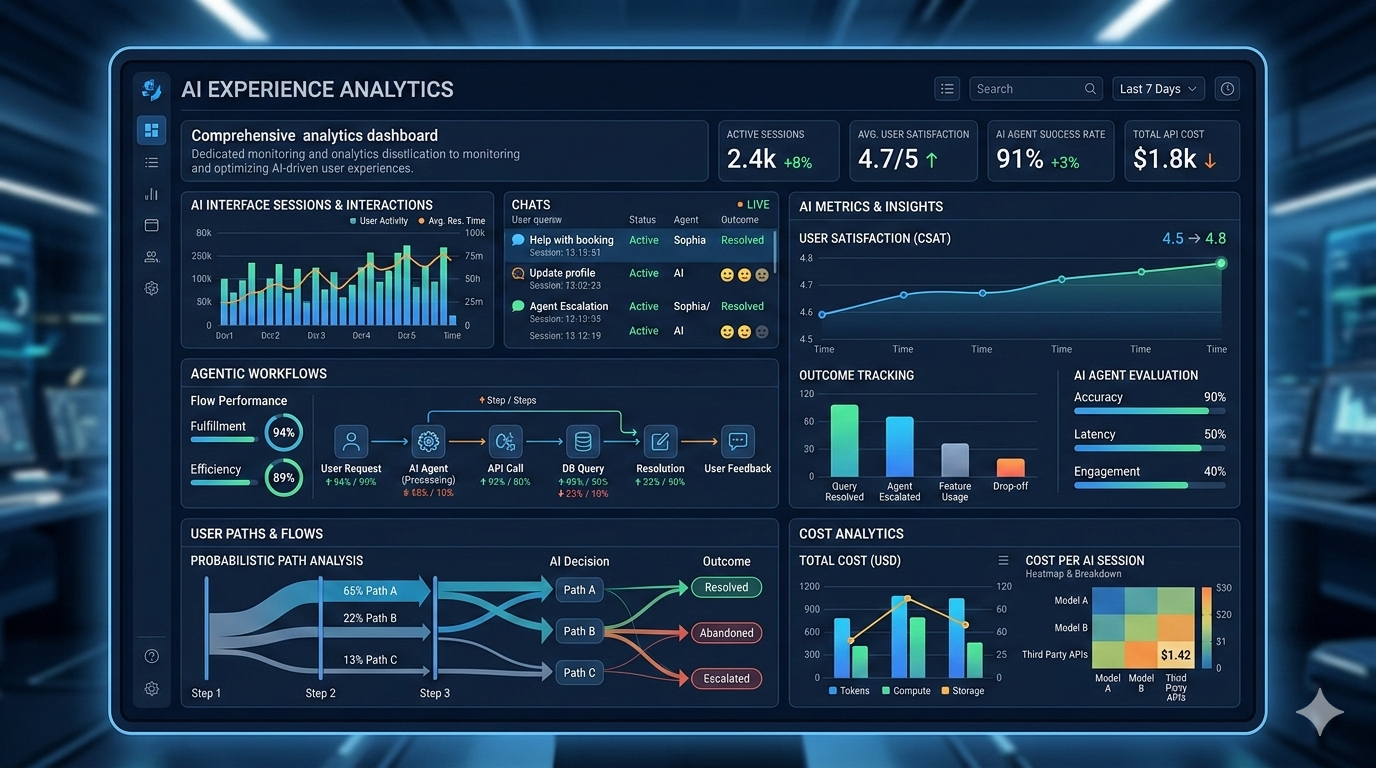
As AI becomes embedded in nearly every digital product, product and engineering teams face a new reality: user behavior is no longer predictable. Traditional analytics frameworks, built around pageviews, clicks, and standard conversion funnels, struggle to capture how people interact with AI-driven experiences.
From chat-based interfaces to agentic workflows that execute multi-step actions on behalf of users, AI changes how people engage. Users don’t always follow linear paths—they explore, iterate, and experiment with prompts in ways that make deterministic tracking nearly impossible. How can teams make data-driven decisions when users’ journeys are probabilistic and dynamic?
This post outlines three major challenges product teams face in measuring AI-enhanced experiences—and practical solutions modern analytics platforms like Amplitude offer.
Challenge 1: Traditional Metrics Don’t Capture AI Outcomes
Problem: In AI-driven workflows, success isn’t always tied to a click or a page view. You can measure downstream effects like retention or revenue, but traditional analytics can’t link these directly to AI-driven interactions.
Solution 1: Treat AI Outcomes as Events
Teams now track AI “evals”—success metrics defined either objectively or via LLM scoring. Events can capture conversation outcomes, usage patterns, or task completion rates. Questions teams can answer include:
- What percentage of AI interactions produce a positive outcome?
- What do users do after an AI fails to complete a task?
- Which topics generate the most friction or frustration?
Solution 2: Use Qualitative Review Tools
Quantitative success metrics alone aren’t enough. Session replays allow teams to watch how users interact with AI, highlighting pain points or confusion. Surveys, optionally scored via NLP, capture user sentiment and subjective satisfaction. Teams can answer:
- Why did users abandon a chat session mid-flow?
- Which AI responses caused frustration despite appearing “correct”?
Solution 3: Tool and Cost Analytics
Tracking which AI tools users engage with, in what order, and at what cost per request helps optimize workflows and ROI. For example:
- Which AI model variant delivers the best satisfaction per cost unit?
- How do feature rollouts affect token consumption and user experience?
Challenge 2: AI Outputs Are Non-Deterministic
Problem: LLMs and other AI models produce outputs that can vary widely even with similar inputs. This unpredictability complicates measurement and experimentation.
Solution 1: Experimentation Frameworks
Teams can use feature flags and controlled experiments to test models, prompts, or parameter changes. Example questions:
- Which system prompt yields the highest satisfaction?
- Does a higher reasoning level improve accuracy but increase latency?
Solution 2: Contextual User Data
AI performance improves when it’s aware of user context. Integrating CRM, in-app behavior, and historical interaction data ensures AI outputs are relevant.
Solution 3: Enriching Profiles via Data Warehouse
Two-way integrations with Snowflake, BigQuery, or Databricks allow enriched user profiles to inform AI workflows, ensuring personalization at scale.
Challenge 3: Dependence on External Systems
Problem: Many AI-driven products rely on third-party APIs. Latency, downtime, or failures can significantly impact user experience.
Solution 1: Latency Monitoring
Automatically track response times and flag problematic workflows. Analytics teams can identify which segments or prompts are affected most and proactively optimize performance.
Solution 2: Feature Flags as Safety Nets
When external dependencies fail or slow down, feature flags allow teams to route traffic to backup systems or fallback AI providers, maintaining uninterrupted user experience.
Is Your Analytics Ready for AI-Enhanced Experiences?
To succeed in an AI-first world, product teams must:
- Combine quantitative and qualitative analytics to understand user behavior deeply.
- Experiment continuously with AI models, prompts, and infrastructure.
- Capture and utilize rich user context across all touchpoints.
- Monitor both experience quality and cost, optimizing for ROI.
AI-first products will continue to evolve rapidly, just like user behavior itself. Teams that adopt these strategies and modern analytics tools will be equipped to learn, adapt, and improve their AI-powered features—even when the path isn’t linear.